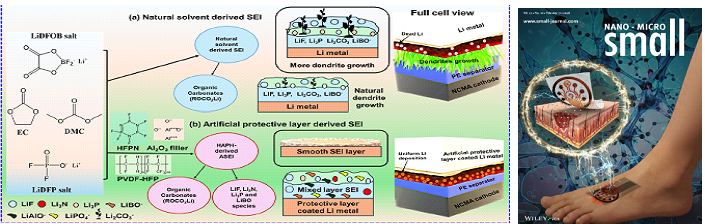
Enhancing Cycling Stability and Suppressing Lithium Dendrite Formation with A Hierarchical Artificial Solid Electrolyte Interphase Layer on Lithium Anodes for High-Voltage Lithium Metal Batteries
|
MCUT Research |
|
Small/ 2026, Vol. 22, 12973 |
|
Enhancing Cycling Stability and Suppressing Lithium Dendrite Formation with A Hierarchical Artificial Solid Electrolyte Interphase Layer on Lithium Anodes for High-Voltage Lithium Metal Batteries |
|
Main authors: Raja Palani, Yi-Shiuan Wu, Rajan Jose, Chun-Chen Yang/ MCUT
|
|
This study develops an artificial SEI (HAPH@Li) composed of HFPN, Al₂O₃, and PVDF-HFP for lithium metal anodes. The layer enhances mechanical strength and ionic conductivity, effectively suppressing dendrite growth and stabilizing the interface. Paired with a Ni-rich NCMA cathode, the full cell delivers >99.62% Coulombic efficiency, 181.9 mAh g⁻¹ capacity, and 75.7% retention after 300 cycles.
|
|
This work can be applied to electric vehicles, energy storage systems, and next-generation portable electronics by enabling safer, high-energy-density lithium metal batteries. The stable ASEI design improves cycle life and reliability, supporting fast charging and long-term operation. It is also relevant for aerospace and high-performance devices requiring lightweight and durable energy solutions. |
|
This technology can significantly improve the safety, reliability, and energy density of batteries, enabling longer-lasting electric vehicles and reducing dependence on fossil fuels, thus lowering carbon emissions. It supports the development of sustainable energy storage systems for renewable sources like solar and wind. Additionally, it enhances portable electronics and medical devices, improving daily life convenience and healthcare outcomes while contributing to a cleaner and more sustainable future. |